Showing posts with label black swan. Show all posts

Sunday, May 22, 2011

OUT & ABOUT...


As well as kingfishers, black-fronted terns (Above) are also common visitors to the coast during the colder months, So lately I've found myself venturing to one of my favourite spots just out of Christchurch to photograph these handsome little birds. I got up early yesterday morning to continue my quest in capturing the terns, It was a beautiful day with soft Autumn lighting, and I spent the best part of the morning crawling after a group of roosting terns who would scatter every now and then as a dog or walker would venture to close to the resting flock. Keep an eye out for a black-fronted tern post!! I managed to see a white-winged black tern which was a first for me (uncommon Asian migrant)! 


On the way back from photographing the terns I was reacquainted with an old friend, a black stilt Himantopus novaezelandiae (above), who I've been photographing in this area on and off for the past few years. Black stilts are endemic to New Zealand and are still considered the world's rarest wading bird!!! There were only 23 black stilts left in 1981. So it was a real pleasure to spend time photographing this beautiful bird who has been hanging out with it's more common cousins, pied stilts (below). Thanks to intensive management numbers are on the increase, according to a February 2010 estimate there was 85 black stilts in the wild.


                                                                                                                                      Female blackbird

                                          Young mallard ducklings follow each other over the Lilly pads

                                                                                                     Male California quail

                                                                                                                                           Male Bellbird 

                                                                                   Little blue penguin, Kaikoura, NZ


Shag Rock, one Christchurch's iconic natural formations will never be the same after the 6.3 magnitude earthquake which hit here on February the 22nd 2011. The photo on the right is what shag rock looked like before the quake and below are photos of Shag Rock now (Shag Pile)... I think it still has some charm and almost looks like a giant hand pushing up through the rubble (if you look hard enough)...


Saturday, October 16, 2010

SPOTLIGHT: Pied Stilt (Poaka)


Pied stilts (Himantopus himantopus leucocephalus) or black-winged stilts as they are also known, are a common native to New Zealand and are also found in Australia, Indonesia, the Philippines, and the Bismarck Archipelago.

Pied stilts are found throughout the world and the classification of these birds can be controversial as they differ  from place to place. Some believe that there are as many as five separate species while others consider them to be subspecies.  Whatever the case may be the pied stilts found here Himantopus himantopus leucocephalus or poaka as the Maori know these beautiful birds are classified by an all-white head, neck white, black behind, open black chest band and usually a white band across upper back.

Pied stilts are found in a variety of habitats such as sheltered marine harbours, wetlands, estuaries, lagoons, riverbeds, waterlogged pastures and lakesides where they use their extremely long and lanky legs (which give them their name) to wade through the water in search of small insects, marine molluscs, worms and crustaceans which are probed out of the sand or mud. In winter many of the birds that breed on Canterbury's rivers migrate to the warmer North Island harbours to feed.

Breeding and nesting can occur as early as July in the northern part of the country and can continue into summer. Nests are usually built on the edge of wetlands/lagoons or above the high-tide mark on sandy beaches and riverbeds. The stilts are very vocal at this time of year and if an intruder ventures too close to their nest or young they make sharp yapping calls and  often feign a broken wing in order to draw attention away from their exposed nest or young. The female usually lays four eggs which are incubated by both parents. Incubation usually lasts for 25 days. The chicks usually leave the nest the same day after hatching and are covered with a soft down with speckled yellow-brown upper-parts and white under-parts. When danger threatens they drop straight to the the ground and remain motionless becoming extremely difficult to detect. 


Above: A young stilt finds its legs on the estuary mud
Right: A pied stilt incubates it's eggs in waterlogged pasture.


Left: A newly hatched chick sits on its nest, stilt chicks usually leave the nest the same day. 

Below: A newly hatched chick soaks up some rays, a relief after being cramped in the egg for 25 days :)

Tuesday, August 31, 2010

Spring greetings


It’s that time of year again, time to defrost and shake off the winter blues! For a wildlife photographer Spring’s arrival brings so much anticipation and excitement. It’s a time to capture the essence of new life from territorial disputes to nesting birds and incredible courting displays. It’s a time to finish last year’s projects and to start new ones… so much to do and so little time. This is truly an amazing time of year!!!

So here's a few spring shots to start of another season :) 

Pukeko Nest, Christchurch
  
Pukekos are very social birds, and copulation and courtship within a territory occurs between all adults members, this social breeding is thought to help synchronize sexual cycles allowing several females to lay in the same nest at the same time.  Incubation is shared by both males and females and only adults incubate. Each female will lay up to 6 eggs, and a communal nest can have up to 12 eggs from 2-3 females.


Pukeko chick, Christchurch

Being highly social birds, all birds in a territory assist with chick care, so each chick may have a parent, aunt/uncle, older brother/sister as a minder. In this photo an older family member helps feed a chick.


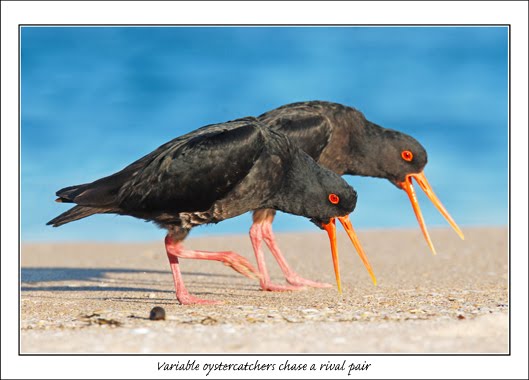
Variable Oystercatchers, Opoutere Beach

A pair of endemic variable oystercatchers (Haematopus unicolor) patrol their territory. Variable oystercatchers are very territorial during the breeding season and will defend their territories sometimes aggressively. Nests are laid in a shallow dish of sand or shingle where the female lays 2-3 eggs.


Black swan cygnets, Christchurch

In this photo two black swan cygnets hitch a ride on mum's back. Parents often carry young cygnets on their backs  for protection and warmth. Cygnets are tended by their parents for approximately 6 months.


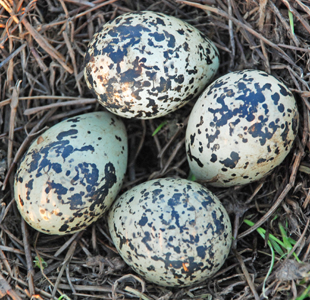
Banded dotterel nest, Lake Ellesmere

The banded-dotterel nest is a simple, well disguised scrape in the ground where usually 2-3 eggs are laid. Incubation is shared by both sexes. In April most birds migrate to Australia or the north of the North Island where they escape the cool temperatures of the South Island winter (smart birds).  Notice the two bands across the birds breast which give the bird its name.