Showing posts with label nest. Show all posts

Wednesday, November 27, 2013

Kāruhiruhi PIED SHAG


This year has seen me go back to university, where I am currently 12 months through a 15 month graduate teaching diploma through the University of Canterbury. This year's busy schedule has meant that my photography has been put on the back burner, and apart from a few brief trips, I've been running on the pedagogical treadmill. So naturally I've had an itchy shutter finger, and been dreaming of pointing the camera at some of my avian friends.

Although my photography has slowed down, there has been some photographic progressions. This year I received an Associateship through the Nature Photography Society of New Zealand (ANPSNZ) and the Photographic Society of New Zealand (APSNZ). I also received honours in this years Trenna Packer Salver for my 'Sea Lion Stare-down' image. My exhibitions have continued and I will be showcasing some images in Hanmer Springs in January 2014.

As the last few weeks of university came to an end, I managed to photograph a local pied shag pair (Phalacrocorax varius) as they brought up their three rapidly growing chicks. What a joy to be able to observe the pair as they built their nest, fed their chicks and interacted with one another. I really enjoy just sitting and watching nesting birds, it's amazing what you see and learn. 

What surprised me when watching this particular pair was the nest building. I was surprised to witness the chicks aiding their parents in nest construction and maintenance. I've witnessed a juvenile Australasian crested grebe aid parents with nest construction for a second clutch, although I have never observed chicks nest build while still nest bound. 

The adult would bring an offering of nest material, usually a stick, and would be greeted by it's nesting partner, who would often throw its head back and commence in a 'yawn' like greeting. The stick would be passed from adult to adult and occasionally to the chicks who would place and fasten the stick to the nest (family team work). 

I hope you enjoy the images below...

As soon as my last assignment was submitted I packed the bags and embarked on a nine day photo trip... photos to come.... keep an eye out!   

Above: Commonly described as "wing-drying" the adult dries it's wings after feeding. Note: Breeding colours present around the eye.

A whole new world: two young chicks peer out of the nest inspecting their new surroundings under their parent's watchful eye.

Begging for a feed: two young chicks beg for a feed, triggering a regurgitation reflex.

Sheltering from the elements: with a soft new down, the young chicks, shelter on a chilly evening.

With its head completely enveloped, a rapidly growing chick receives a stomach full of fish.


Nest construction - a family affair: A stick is passed down to the chick to place on the nest. 


Messy eater: A couple of fish miss their intended target.

Greetings: Greeted by a "yawn", an adult returns to the nest for a swapping of nesting duties.


'Ginger shag': When photographing the' pied shags' I was visited by this strange looking 'little pied shag'.

...Thanks for viewing...

Wednesday, February 20, 2013

Australasian Crested Grebes, Lake Lyndon

LAKE LYNDON | CANTERBURY

For those who missed seeing some of my 'Wild Aotearoa' exhibition at the Green Room Cafe it is now showing at the Restaurant@Rossendale. Rossendale is a beautiful winery situated just outside of Christchurch. So if you want to go and have a nosy and one of their famous Rieslings go and have a look!  

Rossendale Winery: 136 Old Tai Tapu Road Christchurch 8025    |    http://www.rossendale.co.nz/  

It was love at first sight when I first laid eyes on the magnificently handsome Australasian Crested Grebes or kāmana as they are known in Maori. Kāmana have captivated and intrigued me for the last few years. These birds belong to an ancient order of diving water birds found on every continent in the world. They are renowned for their mating displays and the way young grebes ride among plumage on the back of their swimming parents. Three of the 22 species in this order have become extinct in the last 30 years, and unfortunately Australasian crested grebes are endangered here in New Zealand with approximately 300-400 birds remaining. 

|   Australasian Crested Grebe Nest   |   Lake Lyndon   |   18mm   |   1/320sec   |   f/13   |   ISO500   |   

When I heard there was a pair of Australasian Crested Grebes nesting at Lake Lyndon, in the Canterbury high country I couldn't help but have a look. Lake Lyndon is a relatively small alpine lake and has little to no substantial tree cover except for a few stunted willows, this makes finding the birds relatively easy. I took a trip up to the Lake one Saturday afternoon in hope of having a 'reccy' and locating the nest. The lake was quite busy due to weekend activities and finding the birds proved extremely difficult... they weren't in their usual nesting locations and I began to wonder if I was I too late? Had the nest failed? Were the birds laying low due to the increased human activity on the lake? As the sun set behind the mountains I decided to give up the search and have some dinner... I pulled up to the quiet side of the lake and set up my camp stove; as the water was boiling I noticed some movement in one of the small willows right in front of where I was sitting - I had managed to park within 50 metres of this interesting grebe's nest!

What was particularly surprising was that this nesting pair had already successfully brought up a healthy juvenile and had decided to nest again. It is not uncommon for grebes to re-nest after a failed nest attempt, but to re-nest while looking after a rapidly growing youngster was unusual, in fact I haven't heard of this behaviour before. Furthermore, it was helping its parents build the new nest for its younger siblings. WOW! It would watch its parent dive to collect weeds and twigs to place on the nest, and then copy its parents by placing small bits of weed onto the nest itself. What an amazing privilege to watch this interesting learning behaviour in front of my very eyes! Unfortunately the light was now well behind the mountains to the West and photography was out of the question!
 
|   Australasian Grebe with Juvenile in the Morning fog   |   Lake Lyndon   |   390mm   |   1/400sec   |   f/7.1   |   ISO640   |

I had to get back up there to see if I could photograph these amazing birds! I was able to free up a couple of days around Waitangi Day. I drove up to the lake after work and spent an extremely disrupted sleep in the back of the car due to high winds and cool high country temperatures - I woke to the sound of a couple of angry skylarks chasing a sly stoat around outside the car. Rain, mist and howling winds made for less than desirable photographic conditions and what was worse was that one of the adult birds and the juvenile were nowhere to be seen. I spent the day watching the nest from a distance hoping to see the two birds return and relieve the poor incubating parent who looked as if it had a rougher night than me. The day slowly disappeared and still no sign of the missing birds - I was beginning to lose hope as I had seen a grebe predated on this lake a couple of years back and began to wonder if the stoat had got to one or both of the birds. At around 6pm that evening I was elated when I saw from a distance two grebes returning to the nesting site - yes they had finally returned after perhaps spending the whole day sheltering from the strong winds... I imagined how happy the incubating parent would have been to see these two return. Once back, there was a little socialising and some nesting building before a change of incubating duties...phew! The sky was dark and the wind still made it difficult to get any decent shots so I happily watched the grebe family while enjoying a cuppa - I would hopefully get some better weather and some photo opportunities tomorrow.
 
I awoke early to a still, quiet, foggy morning; the sun had not yet broken the horizon and I was relieved to see all three birds around the nesting site. As the light started to appear through the fog I was able to get to work capturing the grebes in the mist (above). The fog, light and calm conditions made it possible to create some interesting images of the nesting (below).
 
|   Australasian Crested Grebe's Nest   |   18mm   |   1/80sec   |   f/11   |   ISO640   |

The sun began to slowly burn off the fog, creating one of the most beautiful high country mornings I have ever experienced! Soon there was enough light to capture the grebes carrying all sorts of interesting nesting materials (below).
 
|   Australasian Crested Grebe with nesting material   |   360mm   |   1/640sec   |   f/7.1   |   ISO400   | 
|   Australasian Crested Grebe with nesting material   |    175mm   |   1/640sec   |   f/7.1   |   ISO400   |
|   Juvenile Australasian Crested Grebe stretching    |    420mm   |   1/1000sec   |   f/7.1   |   ISO400   | 

As the sun rose and the temperature increased the fog totally lifted and revealed a beautiful high country day. The juvenile grebe was extremely inquisitive and happily preened, hassled its busy parents, stretched (above) and played in the clean and cool alpine waters of Lake Lyndon. Australasian Crested Grebes' legs sit well back on their bodies which make them extremely strong swimmers. As a result the grebes spend their entire lives on the water and they are extremely awkward on land. I spent the afternoon photographing the grebe family -what a wonderful way to spend Waitangi Day. Even though the trip had started off a little rough these special moments made the trip worthwhile. NZ scaups, black-backed gulls, shags, pied stilts, south island pied oystercatchers (SIPOs), banded dotterels, skylarks, NZ pipits, and harriers also resided on the Lake. I managed to snap this SIPO (below) as it had a lazy stretch on Waitangi Day!
 
|   South Island Pied Oystercatcher Stretching  |   390mm   |   1/640sec   |   f/7.1   |   ISO500   |
 
|   Australasian Crested Grebe Eggs   |   Lake Lyndon   |
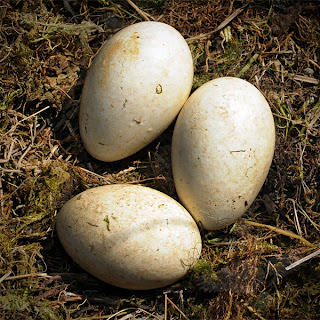
Last Friday morning I returned to Lake Lyndon with a few friends in hope of photographing the grebes with their newly hatched chicks. We arrived up at the Lake to find three cold abandoned eggs! It is always upsetting as a photographer and conservationist to witness an abandoned nest, especially when you watch firsthand the effort that the parents put into building and incubating. Unfortunately this is not an uncommon occurrence in nesting grebes. In fact an extremely high percentage of nests failed this year in Lake Pearson and Lake Lyndon! Strong winds, choppy waves  and rising lake levels can often flood grebe's nests and wash generated by motorised watercraft can also swamp nests and destroy eggs. Noise and predators can scare adult birds off their nests and leave chicks exposed to the cold or predators. The water levels in the Lake were much lower than the week before and had left the nest vulnerable to land based predators. We wondered whether over inquisitive people or animals such as stoats, cats or raptors had scared the adults off the nest.
 
Thanks for stopping by! A previous Australasian Grebe Blog can be viewed here: http://jonathanharrodphotography.blogspot.co.nz/2011/02/australasian-crested-grebes.html 

Sunday, February 20, 2011

Australasian Crested Grebes

I wasn't holding too much hope for getting the shots I wanted as I packed up my photography gear, although the thrill of what the weekend had in store made the last couple of hours at work fly by!  Photos or not, I was keen to get away and spend some time with my brother and a mate. There is no room for pessimism when it comes to wildlife photography, but I couldn't help feeling a little pessimistic as the last few attempts at capturing the crested grebes had ended with very little results. A few months ago I had gone up to Lake Lyndon to photograph a grebe's nest with a mate of mine only to find the nest abandoned and a recently devoured adult bird close to the nest. Grebes often bury their eggs with nesting material when leaving the nest unattended and I could see a partly covered egg on the abandoned nest - I hoped that the remaining adult would return to incubate the eggs although this seemed unlikely as the nest remained unattended throughout the day. It was a real shame to see this act of predation on one of New Zealand's rarest waterfowl!

We were treated to a beautiful but short sunrise on the Saturday morning as it soon clouded over and remained overcast for most of the day (which helped diffuse the light nicely). I was surprised to find a nest this late in the season and I was told that it was this pair's second attempt at nesting, as their first clutch hadn't survived. I had a great time photographing the birds diving, nest building, incubating and feeding their new born chick - what an amazing day with these beautiful birds! I was surprised to see the adult birds feeding their young chick feathers which, from what I've read, is thought to be a method of protecting the chick's from gut trauma caused by sharp fish bones. Lets hope that these amazing birds will increase in numbers!


Saturday, October 16, 2010

SPOTLIGHT: Pied Stilt (Poaka)


Pied stilts (Himantopus himantopus leucocephalus) or black-winged stilts as they are also known, are a common native to New Zealand and are also found in Australia, Indonesia, the Philippines, and the Bismarck Archipelago.

Pied stilts are found throughout the world and the classification of these birds can be controversial as they differ  from place to place. Some believe that there are as many as five separate species while others consider them to be subspecies.  Whatever the case may be the pied stilts found here Himantopus himantopus leucocephalus or poaka as the Maori know these beautiful birds are classified by an all-white head, neck white, black behind, open black chest band and usually a white band across upper back.

Pied stilts are found in a variety of habitats such as sheltered marine harbours, wetlands, estuaries, lagoons, riverbeds, waterlogged pastures and lakesides where they use their extremely long and lanky legs (which give them their name) to wade through the water in search of small insects, marine molluscs, worms and crustaceans which are probed out of the sand or mud. In winter many of the birds that breed on Canterbury's rivers migrate to the warmer North Island harbours to feed.

Breeding and nesting can occur as early as July in the northern part of the country and can continue into summer. Nests are usually built on the edge of wetlands/lagoons or above the high-tide mark on sandy beaches and riverbeds. The stilts are very vocal at this time of year and if an intruder ventures too close to their nest or young they make sharp yapping calls and  often feign a broken wing in order to draw attention away from their exposed nest or young. The female usually lays four eggs which are incubated by both parents. Incubation usually lasts for 25 days. The chicks usually leave the nest the same day after hatching and are covered with a soft down with speckled yellow-brown upper-parts and white under-parts. When danger threatens they drop straight to the the ground and remain motionless becoming extremely difficult to detect. 


Above: A young stilt finds its legs on the estuary mud
Right: A pied stilt incubates it's eggs in waterlogged pasture.


Left: A newly hatched chick sits on its nest, stilt chicks usually leave the nest the same day. 

Below: A newly hatched chick soaks up some rays, a relief after being cramped in the egg for 25 days :)

Sunday, September 26, 2010

The Red Beak District

THE RED BEAK DISTRICT 
PROMISCUOUS PUKEKOS

Forget 'Fort St' in Auckland or 'Kings Cross' in Sydney, there are far more sinister districts popping up all over the place at this time of year. From August to March every year New Zealand's recreational parks and open fields are transformed into 'Red beak districts' where promiscuity and 'fowl play' is the name of the game!

Pukekos (Porphyrio porphyrio) would have to be the hippies of the avian world, a world that consists of 'free love' and communal living! Group sex, partner sharing, homosexuality and incest are a common occurrence. In fact, in the pukeko world you could say that love is one big 'family affair'.  (Right: No privacy in a pukeko commune)

Pukeko's have a complex social system, and monogamy, polygamy, polyandry,  and polygynandry can occur  within the same population! Females are often hounded by numerous males and can be copulated by up to three different males within a matter of minutes! (Below:  Males hastily pursue an unwilling female)

This kind of libertine lifestyle raises a lot of questions... how could this level of promiscuity benefit the pukeko? Partner sharing seems to go against the evolutionary grain, where it is argued that as a result of natural selection individuals will try and maximize their own genotype in subsequent generations. Although in communal breeding groups it seems that they toss their own interests aside in order to assist the reproductive efforts of others and benefit the group as a whole.

There are many theories as to why these purple clad hippies share mates and participate in incestuous and homosexual activity when it seems detrimental and pointless to their evolutionary success.

When it comes to inbreeding it seems that pukeko have several mechanisms for reducing the disadvantages of incest such as possible gamete selection (the process of determining which egg matures and what sperm succeeds in fertilizing the egg). Other theories suggest that regular inbreeding may have eliminated deleterious generic consequences. Whatever the reason or reasons may be, there have been no obvious harmful effects due to inbreeding observed in pukeko breeding groups. Homosexuality and partner sharing are believed to help synchronize sexual cycles allowing several females to lay in the same nest at the same time.

Although these raunchy rails' sexual habits may seem a little lewd and communal breeding an evolutionary paradox, these districts, believe it or not, are 'family friendly'. In fact these lewd acts seem to benefit the group as a whole, and strengthen family ties. Community breeding offers its fair share of advantages, such as safety in numbers as each 'commune' has several males to defend it. It certainly makes the jobs of nestbuilding (Below), chick feeding/care (Right) and incubation (which is shared by all adults within a group) a bit easier with more helpers around. Due to the fact that males and females mate freely within the group, males have an uncertainty about which chicks they've fathered and this probably ensures that they  stick around and help with the raising of the chicks.

Each female will lay up to 7 eggs, and a communal nest can have eggs from 2-3 females. Unaware of the pukekos communal nesting behaviour early ornithologists were fooled into thinking that some females were highly productive because their nests contained up to 20 eggs. With multiple chick minders each chick may be looked after  by a parent, aunt/uncle or an older brother/sister.


Left: Males and females both participate in nest building, and in communal breeding groups helpers also lend a hand (or a beak).


Right: allopreening. In pukekos, allofeeding and allopreening (where birds will feed and preen one another) is a form of courtship and occurs between all sexually active birds in a group. Male pukeko also hold water weeds in their bill and bow to the female with loud chuckles as a form of courtship. 


Left: A pukeko swimming. Although not web-footed, pukekos are surprisingly strong swimmers.

Below: A pukeko nest  situated in an open field.