Showing posts with label chick. Show all posts

Sunday, February 20, 2011

Australasian Crested Grebes

I wasn't holding too much hope for getting the shots I wanted as I packed up my photography gear, although the thrill of what the weekend had in store made the last couple of hours at work fly by!  Photos or not, I was keen to get away and spend some time with my brother and a mate. There is no room for pessimism when it comes to wildlife photography, but I couldn't help feeling a little pessimistic as the last few attempts at capturing the crested grebes had ended with very little results. A few months ago I had gone up to Lake Lyndon to photograph a grebe's nest with a mate of mine only to find the nest abandoned and a recently devoured adult bird close to the nest. Grebes often bury their eggs with nesting material when leaving the nest unattended and I could see a partly covered egg on the abandoned nest - I hoped that the remaining adult would return to incubate the eggs although this seemed unlikely as the nest remained unattended throughout the day. It was a real shame to see this act of predation on one of New Zealand's rarest waterfowl!

We were treated to a beautiful but short sunrise on the Saturday morning as it soon clouded over and remained overcast for most of the day (which helped diffuse the light nicely). I was surprised to find a nest this late in the season and I was told that it was this pair's second attempt at nesting, as their first clutch hadn't survived. I had a great time photographing the birds diving, nest building, incubating and feeding their new born chick - what an amazing day with these beautiful birds! I was surprised to see the adult birds feeding their young chick feathers which, from what I've read, is thought to be a method of protecting the chick's from gut trauma caused by sharp fish bones. Lets hope that these amazing birds will increase in numbers!


Saturday, October 16, 2010

SPOTLIGHT: Pied Stilt (Poaka)


Pied stilts (Himantopus himantopus leucocephalus) or black-winged stilts as they are also known, are a common native to New Zealand and are also found in Australia, Indonesia, the Philippines, and the Bismarck Archipelago.

Pied stilts are found throughout the world and the classification of these birds can be controversial as they differ  from place to place. Some believe that there are as many as five separate species while others consider them to be subspecies.  Whatever the case may be the pied stilts found here Himantopus himantopus leucocephalus or poaka as the Maori know these beautiful birds are classified by an all-white head, neck white, black behind, open black chest band and usually a white band across upper back.

Pied stilts are found in a variety of habitats such as sheltered marine harbours, wetlands, estuaries, lagoons, riverbeds, waterlogged pastures and lakesides where they use their extremely long and lanky legs (which give them their name) to wade through the water in search of small insects, marine molluscs, worms and crustaceans which are probed out of the sand or mud. In winter many of the birds that breed on Canterbury's rivers migrate to the warmer North Island harbours to feed.

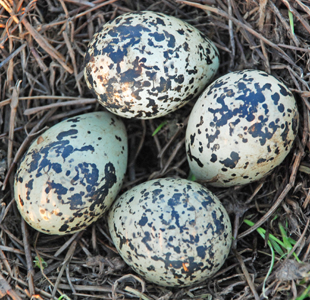
Breeding and nesting can occur as early as July in the northern part of the country and can continue into summer. Nests are usually built on the edge of wetlands/lagoons or above the high-tide mark on sandy beaches and riverbeds. The stilts are very vocal at this time of year and if an intruder ventures too close to their nest or young they make sharp yapping calls and  often feign a broken wing in order to draw attention away from their exposed nest or young. The female usually lays four eggs which are incubated by both parents. Incubation usually lasts for 25 days. The chicks usually leave the nest the same day after hatching and are covered with a soft down with speckled yellow-brown upper-parts and white under-parts. When danger threatens they drop straight to the the ground and remain motionless becoming extremely difficult to detect. 


Above: A young stilt finds its legs on the estuary mud
Right: A pied stilt incubates it's eggs in waterlogged pasture.


Left: A newly hatched chick sits on its nest, stilt chicks usually leave the nest the same day. 

Below: A newly hatched chick soaks up some rays, a relief after being cramped in the egg for 25 days :)

Friday, October 8, 2010

Local wanderings

I'm working on a few photographic projects at the moment and I've been able to spend a fair bit of time down at my local estuary (Avon/Heathcote) here in Christchurch. While some projects are in the making I thought I'd add a few shots that I've taken this week in between photographic ventures. I really enjoy getting to know the ins-and-outs of the estuary and I find that the more time I spend down there the more I learn about the habits and behaviours of my feathered friends :)

Photos from top to bottom. Backlit white-fronted tern. Mallard duckling. NZ kingfisher and crab. Shag Rock a prominent feature of the Avon/Heathcote Estuary (an older photo).