Showing posts with label birds. Show all posts

Friday, December 20, 2013

South

Handing my last assignment into the office signified the end of a long university year and the beginning of a nine day photographic expedition. Minutes after handing the paper in, I was heading South down State Highway One full of anticipation and buzzing with excitement. 

I planned to spend the first few days around Lake Tekapo, in hope of photographing nesting wrybill, Australasian crested grebes, and of course the rare and endangered black stilts. When I arrived at the campgrounds that evening, I was surprised to spot four rare creatures feeding at the edge of the lake, usually solitary creatures, four wildlife photographers were gathered at the lake's edge. It was nice catching up with Glenda Rees, Craig McKenzie and Tim Rumble & Nick Rumble and we happily chatted the night away about bird photography. The next few days presented opportunities to photograph nesting and brooding wrybill, black stilts and Australasian crested grebes. An elusive marsh crake also made an welcome appearance. 

Above: Wrybill nest: Nothing more than a scrape in the ground, a wrybill stands over a solitary egg.

Above: A male wrybill, broods its young chick. Note: The curved bill that gives the wrybill its' name.

Sporting a sideways turning bill, the endemic wrybill (Anarhynchus frontalis) or ngutuparore is one of New Zealand’s bird oddities – the only bird in the world with such a feature. It uses the bill like a hook to gather insect larvae and eggs from beneath stones, or as a spoon to scoop crustaceans from mud. It's hard to estimate the population of these small cryptic plovers, wintering flocks suggest a total population of 5000-5500, although counts show high variability (which obscures trends); unfortunately the population is believed to be declining.

Brooding Mother: A young chick seeks shelter from its mother. 

After a few days around Lake Tekapo, I headed South towards Lake Pukaki, in the hope of photographing New Zealand's original 'All Blacks', the black stilt (Himantopus novaezelandiae), which are an extremely rare endemic bird (found only in New Zealand). Māori call these rare birds Kakī and regard them as a taonga – a living treasure. I always feel extremely fortunate to photograph these birds in their natural habitat. Kakī have black and white plumage until the age of 18 months when they acquire their black plumage. In 1981 kakī numbers declined to a low of just 23 birds, and thanks to the continuing efforts and intensive management their are currently approximately 100 birds. 

  Above: An adult black stilt in full adult plumage.
 Above and below: Two young black stilts mate. Black stilts are known to mate for life.
 
Above: The male drapes his wing over the female as they cross bills in a stylised mating ritual.


Along with wrybill and black stilts, New Zealand's braided rivers provide important nesting grounds for another of New Zealand's rare and endemic birds, New Zealand's original 'Black Caps', the black-fronted tern. These stylish small terns sport a stunning blue-grey coat which is contrasted by their black cap and bright orange beak and legs. There is an estimated population of between 5,000 - 10,000 individuals. When nesting their diet consists of emerging nymph and subimago mayflies, fish, earthworms, grass grub larvae and skinks etc.

Above: An adult black-fronted tern in full breeding plumage. 
 
Above: An adult and small chick on the nest, their nests are simple scrapes amongst river stones. 

I couldn't venture South without visiting my old friends, the fiordland crested penguins. I arrived a little later on in the nesting season this year, which revealed a different side to these photogenic penguins. Arriving a little later meant that most chicks were close to leaving their nesting sites. It was a thrill to witness a few young, adventurous penguins making their way to the ocean for possibly their first time. For the young penguins the beach was like a playground, the pebbles, boulders, and water provided exiting new experiences.
 
 Above: Holding Hands: Fiordland crested penguins make their way to the ocean after an evening at the nest. 
Above: A young fiordland crested penguin strolls down to the beach.

Above: A young adventurous fiordland crested penguin plays in a puddle.


On the way back to Christchurch, I payed a quick visit to another, perhaps less known New Zealand endemic, the fernbird. Fernbirds inhabit wetlands throughout New Zealand, but are rarely seen because of their secretive nature.

Fernbirds are closely related to the grassbirds Megalurus of Australia, and can be identified by their loose and tattered fern-like tail.

Regarded as tapu, Māori revered the Fernbird as an "oracle" or "Wise bird" (Manu tohu). The calls of the bird were interpreted as heralding success or failure in daily activities such as fishing but on a more serious level could also portend prosperity and health or disaster and death. Fernbirds were also offered as a sacrifice when the Maori returned home from an unsuccessful war. Right: Fernbird with nesting material.

In January 2014, I will be exhibiting some photographs at the Amuri Community Arts Gallery in Hanmer Springs. I will be hanging the exhibition on the 4th of January and will be personally there from the 4th - 6th of January. So if you are up in that direction or feel like a day trip to the picturesque Hanmer Springs come have a look and a chat. 

January 2014   |   Amuri Community Arts Gallery   |   Cheltenham St, Hanmer Springs, Hurunui
 
 Below: 2014 Range of Jonathan Harrod Photography business cards.
Thanks for viewing!

Sunday, May 6, 2012

THE WILD SOUTH

I recently attended PSNZ's National Convention in Invercargill, Southland. A big thanks once again to the Ronald Woolf Memorial Trust for helping fund my trip!!! I had a fantastic time meeting fellow photographers from all over New Zealand and Australia, it was great to put faces to names, join in on some great tutorials, workshops, field trips and spend time listening to some inspiring speakers. It was really enjoyable being able to immerse myself in photography in such a wonderfully warm and friendly environment.

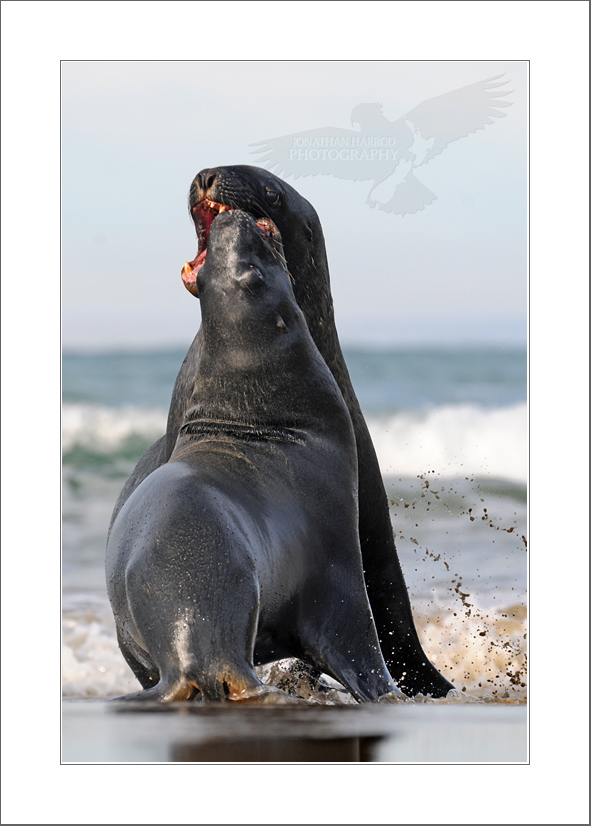
The convention also gave me a good opportunity to explore the Southland area. I gave myself a few days either side of the convention to photograph the wildlife in and around the Catlins coast. The Catlins is an area of unspoilt beauty and home to numerous species of marine life due to the nutrient rich waters. I particularly wanted to concentrate on two rare marine species the yellow-eyed penguin (hoiho) and the New Zealand sea lion (hookers sea lion).

|  Rough seas, Curio Bay, Southland  |


I love photographing penguins and the yellow-eyed penguin or hoiho were the first stop on my Southland adventure, I had a fantastic time photographing the yellow-eyes and it was great being able to spend some time with the rarest penguin in the world. I arrived in the small coastal township of Moeraki mid-afternoon after the drive from Christchurch and I was really looking forward to getting out of the car and exercising my legs and shutter finger :) As with many penguins species, their loud shrill-like calls alerted me to their presence before getting a sighting, in fact their Māori name, hoiho means 'noise shouter'. Moeraki has great access to the penguins, although the area is heavily fenced off due to the many penguin nesting sites! Fortunately the penguins don't stick within the fences and roam about freely allowing for some great interaction and photographic opportunities. Although the fencing can be a little frustrating for a photographer, the fence's importance was reinforced when I witnessed three tourists literally chase a highly stressed penguin around in hope of getting a snapshot standing next to the poor bird!!! Not all people unfortunately put the welfare of the penguins above a photograph.    


Yellow-eyed penguins are unique to New Zealand and found scattered along the south-east of the South Island. I gave myself a few days after the convention to photograph the yellow-eyed penguins in the Catlins, although I found myself hunkered down for the majority of the time in a little old caravan sheltering from the gale force winds, antarctic wind blasts and downpours of hail, which made a deafening noise against the roof of the caravan - a real glimpse of Southland's dark side! The winds did whip up some impressive swells and I was able to get out in between hail storms and photograph the power of the ocean! It amazes me the swells that the yellow-eyed penguins go out in, and even though they can seem a little clumsy on land, they are the most powerful swimmers!     

|  Surat Bay, Southland  |

Photographing large mammals such as sea lions challenged me in terms of composition; how I fill the frame with my relatively small avian subjects was quite different to how I positioned an adult sea lion. I also found that being at the whim of a 400kg bull sea lion's unpredictable temperament definitely made me more aware of my surroundings. I found the sea lions relatively placid even though I was mock charged a couple of times, especially when testosterone was flying during a play flight or spar. On one occasion I was laying in the sand photographing a female on the Northern end of Surat Bay, there were no other sea lions visible, and I happily spent some time behind the camera confident that there were no other sea lions around. As I snapped away I was unaware of a bull sea lion which was bounding toward me, it must have been sleeping in the high dunes behind the beach... I was alerted by the vibrations in the sand and I can honestly say I don't think I've ever ran so fast - I definitely didn't let my guard down after that, even though probably a playful gesture - I don't think I could handle a sea lion's rough play :) 


|  What you looking at?, Cannibal Bay  |


New Zealand sea lions or Hooker's sea lions (Phocarctos hookeri) are now listed as "nationally critical" and are the world's rarest sea lion. This is the highest threat category in New Zealand and puts them in the same category as the kakapo and Maui’s dolphin! Any species that has undergone a greater than 70% population decline over a period of less than three generations is considered “nationally critical”. Hunting of the sea lions drove them from the NZ mainland approximately 200 years ago, although in the last few years they have slowly made a comeback and there are roughly 150 based on the New Zealand mainland. In 1993 a wonderful thing happened in the small village of Taieri Mouth on the Otago Coast! A solitary female came ashore and gave birth to pup on a local farm, this is believed to be the first pup born on the NZ mainland in over 200 years! Currently the greatest impacts on sea lions are through fisheries by-catch and disease, every year New Zealand sea lions drown due to incidental entanglement in a number of fisheries. Their limited breeding range makes them vulnerable to disease and there have been three mass epidemics of disease over the last 7 years. A Department of Conservation study says that NZ sea lions could be extinct in the next 24 years if there are not tighter restrictions on squid fishing.


Links : | http://www.sealiontrust.org.nz | yellow-eyedpenguin.org.nz | http://www.doc.govt.nz

Wednesday, April 4, 2012

Kingfisher Video & Recent Images

What a good but hectic last few weeks! This time was filled with preparation for this week when I judged a photography competition on Tuesday and gave a talk to the Christchurch Photographic Society on Wednesday!

It was great to judge the New Brighton Photographic Club's natural history competition - it was a mammoth task, commenting on and critiquing 85 images!! Not having much competition background I found that it was a great experience for me. I feel that we all learn from critiquing other's work and I feel it can help us along in our own photographic journeys. We all do it don’t we, often subconsciously… whether it be here online or when we look through magazines or newspapers etc., we find ourselves taking things we like from an image and perhaps thinking about what we would do differently. I feel it’s always a good thing to critique our own work, to take a self-check… we are often our own harshest critics, and I believe that this can be a good thing. Judging gave me a good chance to sit down and think about what makes a good natural history image, what works and what doesn’t. I feel that a good natural history image should be one that captures our immediate attention but also should call for further investigation. We shouldn’t judge ourselves strictly on whether we follow the 'rules' of photography, such as the rule of thirds etc… because photography is open to interpretation and we, as artists, as photographers, portray a scene the way we see it. These rules can often be very helpful in making pleasing images, although we shouldn’t be governed by them. For it’s often when we step outside the box, dare to be different and 'break the rules' that we  make dramatic compositions and create something that is unique!  

I had a great time last night talking to the Christchurch Photographic Society! It was great to be able to share some images with such a welcoming and friendly bunch of photographers. As part of my preparation for the talk  I've spent some time back in the hide in search of some new kingfisher footage to introduce the use of hides in bird photography (the new clip is seen here below, best viewed in HD). Preparing for the talk was a good chance to review some of my photos which I haven't had time to edit in the last few months... I found it fun to rediscover images from some of my recent photographic adventures! Some of those images are shown below... 


I recently won the Ronald Woolf Memorial Scholarship to attend the Photographic Society of New Zealand's National Convention which is held in Invercargill. At the end of this month I will going on a photography trip down to the very south of the South Island of New Zealand. I hope to capture the dramatic colours of New Zealand's Autumn and the amazing wildlife that call the Catlins home! I am really looking forward to meeting photographers from all over the country!!!


Sunday, May 22, 2011

OUT & ABOUT...


As well as kingfishers, black-fronted terns (Above) are also common visitors to the coast during the colder months, So lately I've found myself venturing to one of my favourite spots just out of Christchurch to photograph these handsome little birds. I got up early yesterday morning to continue my quest in capturing the terns, It was a beautiful day with soft Autumn lighting, and I spent the best part of the morning crawling after a group of roosting terns who would scatter every now and then as a dog or walker would venture to close to the resting flock. Keep an eye out for a black-fronted tern post!! I managed to see a white-winged black tern which was a first for me (uncommon Asian migrant)! 


On the way back from photographing the terns I was reacquainted with an old friend, a black stilt Himantopus novaezelandiae (above), who I've been photographing in this area on and off for the past few years. Black stilts are endemic to New Zealand and are still considered the world's rarest wading bird!!! There were only 23 black stilts left in 1981. So it was a real pleasure to spend time photographing this beautiful bird who has been hanging out with it's more common cousins, pied stilts (below). Thanks to intensive management numbers are on the increase, according to a February 2010 estimate there was 85 black stilts in the wild.


                                                                                                                                      Female blackbird

                                          Young mallard ducklings follow each other over the Lilly pads

                                                                                                     Male California quail

                                                                                                                                           Male Bellbird 

                                                                                   Little blue penguin, Kaikoura, NZ


Shag Rock, one Christchurch's iconic natural formations will never be the same after the 6.3 magnitude earthquake which hit here on February the 22nd 2011. The photo on the right is what shag rock looked like before the quake and below are photos of Shag Rock now (Shag Pile)... I think it still has some charm and almost looks like a giant hand pushing up through the rubble (if you look hard enough)...