My trusty old Nikon D80 was finally able to retire on Tuesday! After taking well over 200,000 shots and enduring countless hours of sand blasting, rain showers and all sorts of abuse it was able to take a well-earned break and become my back-up camera to my new Nikon D300s ... well that's what the plan was until yesterday morning...
I was photographing black-fronted terns yesterday morning and really enjoying the fast focus and frames per second (fps) of my new camera when the shutter release button decided to seize up on me!!! I've had the camera for three days and it's already in the shop for repairs!! We'll the trusty old D80 has been brought out of retirement until the D300s is fixed (luckily under warranty)!
 The photo above is of a few of the bar-tailed godwits which have decided to stay here in Christchurch for the winter and earthquakes (brave birds) instead of migrating to Alaska for the summer. The photo to the left is of a juvenile little pied shag drying its wings.
The series below is of the two species of oystercatchers found here in New Zealand, the South Island Pied Oystercatcher (SIPO) and the endemic Variable Oystercatcher.
The South Island pied oystercatchers (Haematopus finschi) unlike their variable cousins breed inland along rivers, lakes and cultivated land; sometimes as far inland as the Southern Alps. In winter the birds congregate on the coast and can be found throughout New Zealand.
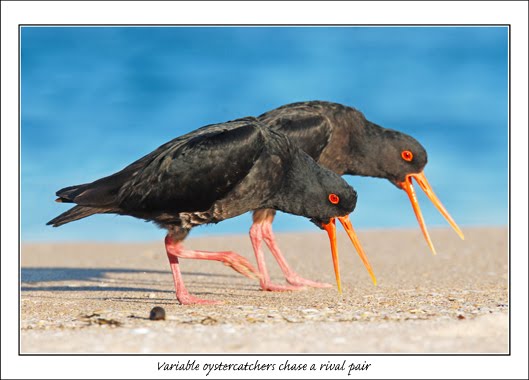
Variable oystercatchers (Haematopus unicolor) breed throughout New Zealand and nest on the coast usually in between rocks or on sand dunes (see the eggs in the photo below). Variable oystercatchers are predominantly black in colour, although their frontal plumage can range from solid black to pied. They can be identified as they are slightly larger than SIPOs.

South Island Pied Oystercatchers approach their high tide roost on the Avon/Heathcote Estuary.

South Island Pied Oystercatcher (Haematopus finschi)

A juvenile SIPO searches for food on the mud flats of the Avon/Heathcote Estuary

Above and below: variable oystercatchers defend their territory from rival pairs


eft: Variable Oystercatcher eggs
* A big thanks to the guys at Photo & Video for having me as their guest photographer last month!
* And thanks to David Streeten from StreetwiseDesign for featuring me on his bulletin board !
I cant wait to get my new camera back!!!