Saturday, April 16, 2011

AFTERSHOCK Kicking it off with Kingfishers


OK, since my last post I've lived through a devastating earthquake and over 1100 aftershocks! Which has some what slowed down the photography and much of life here in Christchurch.  My project to photograph the godwits was put on hold and I will have to wait until their return in September - when they will fly an amazing 11,000km non stop from Alaska back to here to New Zealand.

Winter is now on the doorstep and the days seem to be getting shorter and a lot cooler :-( But not all is as bleak as it may seem for the photography - for with winter comes great lighting and good numbers of kingfishers to the coast!! Kingfishers are one of my favorite birds to photograph and have been a good target species to kick off the photography in this new post quake (hopefully quake free) era!


Sunset kingfisher

'The King' 


A New Zealand Kingfisher regurgitates a large pellet of indigestible crab remains.

Sunday, February 20, 2011

Australasian Crested Grebes

I wasn't holding too much hope for getting the shots I wanted as I packed up my photography gear, although the thrill of what the weekend had in store made the last couple of hours at work fly by!  Photos or not, I was keen to get away and spend some time with my brother and a mate. There is no room for pessimism when it comes to wildlife photography, but I couldn't help feeling a little pessimistic as the last few attempts at capturing the crested grebes had ended with very little results. A few months ago I had gone up to Lake Lyndon to photograph a grebe's nest with a mate of mine only to find the nest abandoned and a recently devoured adult bird close to the nest. Grebes often bury their eggs with nesting material when leaving the nest unattended and I could see a partly covered egg on the abandoned nest - I hoped that the remaining adult would return to incubate the eggs although this seemed unlikely as the nest remained unattended throughout the day. It was a real shame to see this act of predation on one of New Zealand's rarest waterfowl!

We were treated to a beautiful but short sunrise on the Saturday morning as it soon clouded over and remained overcast for most of the day (which helped diffuse the light nicely). I was surprised to find a nest this late in the season and I was told that it was this pair's second attempt at nesting, as their first clutch hadn't survived. I had a great time photographing the birds diving, nest building, incubating and feeding their new born chick - what an amazing day with these beautiful birds! I was surprised to see the adult birds feeding their young chick feathers which, from what I've read, is thought to be a method of protecting the chick's from gut trauma caused by sharp fish bones. Lets hope that these amazing birds will increase in numbers!


Sunday, January 9, 2011

SPOTLIGHT: New Zealand Scaup (Aythya novaeseelandiae)

  NEW ZEALAND'S DIVING DUCK


It's been a while since my last post partly because of the time of year, the weather, and partly because I've been spreading out my time on a few different projects lately. One of which has been building a hide/blind to fit onto my kayak. After a bit of research I noticed that there weren't too many designs that would suit what I needed as a photographic-aquatic hide, so designing and building something from scratch has been a lot of fun. With the help of my grandfather we designed and built the 'kayak hide' over Christmas (so keep an eye out for shots taken from my new floating hide! =D). Another project which has swallowed up some time has been trying to capture one of my favourite NZ duck species - the New Zealand scaup (Papango). These beautiful diving ducks are a real joy to watch and I've spent a fair bit of time watching a few scaup families here in Christchurch bring up some ducklings. I noticed that black-backed gulls are a real predator of young scaup chicks and unfortunately due to predation only a small percentage of the ducklings watched survived. These small ducklings are amazing to watch when feeding as they leap right out of the water as they dive to feed on small aquatic plants and insects under the waters surface. 

The New Zealand scaup (papango) is endemic to New Zealand. At around 40cm it is New Zealand’s smallest duck. Scaup are our only true diving duck. Their legs are set back on their bodies and splayed which make them expert divers but a little awkward on land and therefore they live their lives almost entirely on the water.   
The birds are easily distinguished by their dark glossy plumage. The male has a striking golden eye and a dark coloured head with a purple/greenish sheen. The female can be recognized by her brown eye and brownish body - In breeding plumage, the female scaup has a small white patch above her beak.
They inhabit many deep freshwater lakes or alpine tarns where they can be often seen gathering in large groups especially during autumn.
Hunters in the late 1800s talked about the ease of killing scaup - they were apparently tasty, unafraid and oblivious to hunters and their dogs. Their numbers decreased rapidly soon after European occupation. With complete protection since 1934 the population is increasing and said to be approximately 20,000.

They can dive to a depth of 3 metres in search of small fish, aquatic plants, water snails, mussels and other invertebrates. They unusually remain submerged for about 15 - 20 seconds but can stay underwater to up to 40 seconds.
During the breeding season males can be seen flinging their heads back with the bill pointing up and their body towards the female while whistling softly in an elaborate courtship display.

They nest from October to March and lay six to ten eggs in a nest close to water often under a thick cover of vegetation. The nest is usually lined with grass and down. The female incubates the eggs for about 28 days.
The ducklings take to diving for food very soon after hatching and remain with the parents for up to eight weeks before dispersing. Young scaup have been described as “tiny brown creatures with disproportionate feet, enormous for their body size”.

Thursday, November 18, 2010

Funny Story

Funny story... I was down at the estuary the other day lying face down in the mud (as you do) taking photos of bar-tailed godwits which were feeding on the mud flats at low tide (right). The spot I was in was just off the main road across from some newly built flashy apartment buildings. I was quietly enjoying watching these beautiful birds  through my viewfinder when I noticed that the birds began to stir as if frightened (weird I thought - I was lying motionless and still some distance away it couldn't be me could it?) Anyway I kept snapping for a minute when I heard some footsteps through the mud behind me and before I had a chance to turn around I heard... "It doesn't look good, nah, It doesn't look good!", then I heard a voice call out "Mate can you hear me, are you alright?" It was some poor guy in a suit who thought I was a dead body washed up with the tide!!! Poor guy! He had walked through ankle deep mud to check on me with his good shoes on,."*#@^!" he swore at the fact he got all muddy for no reason! Anyway I thanked him for his concern and he was off on his way - unfortunately I didn't get many shots but I left with a bit of a red face and a funny story hahaha!  

Below are a few photos of birds I've been working on recently (please click on them to view them larger). I've found the New Zealand shovelers (a sub-species of the Australasian shoveler) to be a real challenge photographically... I've found them to be really skittish - making stalking them quite difficult. So I dedicated three afternoons to the shovelers and decided to set up a hide on a small pond which I knew they frequented, and waited for the birds to come to me. On the first attempt this handsome male (below) showed up at the back end of the pond and started dabbling happily away, just out of reach of a good shot - he stayed a frustrating distance away from the camera, as if he knew of the crazed photographer who lay in wait! Luckily for me another male landed shortly after and chased the bird right towards my hide giving me enough time to snap a few pics before flying off. Unfortunately the next two attempts at them didn't yield any better shots :( ... I'll be back out there soon to try again (that's wildlife photography for you).

                                                                                              Male New Zealand Shoveler (Anus variegara)

                                                   Juvenile little pied shag (Phalacrocorax melanoleucos)

                                                                                                       Pied Stilt (Himantopus leucocephalus)

                                        Juvenile Pied Stilt (Himantopus leucocephalus)

                                            The endemic Black-billed gull (Larus bulleri)

Thursday, October 28, 2010

Estuary Royalty

Here are some images from a session I had with the Kingfishers last week.

I was a bit reluctant to go as the wind was blowing a gale, but the time and tides were in my favour so I threw the gear in the car and drove down to the estuary for a session with the kingfishers. I set up the hide (which was flapping violently in the wind) thinking to myself what a waste of time this would be as the kingfishers were probably smarter than me and would be tucked away comfortably out of the elements. Within about 30 minutes of waiting the first kingfisher turned up and landed on the perch in front of me, I don't know how it hung on to the perch with the wind blowing so strongly, although it seemed to be able to hang on and even devour a small mud crab. The winds died down after a while, and I ended up having a great session watching these estuary Kings feed as the sun went down. The photo series on the right shows the kingfisher smashing the legs off the mud crab and devouring it in the windy conditions (notice the rock star hairstyle due to the winds)

The New Zealand sub-species, vagans are said to be a sub-species of Sacred Kingfisher (Halcyon sancta)  which are found in Australia and New Guinea. The New Zealand kingfisher is distinguished from the Australian sub-species by its larger size and broader bill and generally by the distinctiveness of its green and blue colours.


Saturday, October 16, 2010

SPOTLIGHT: Pied Stilt (Poaka)


Pied stilts (Himantopus himantopus leucocephalus) or black-winged stilts as they are also known, are a common native to New Zealand and are also found in Australia, Indonesia, the Philippines, and the Bismarck Archipelago.

Pied stilts are found throughout the world and the classification of these birds can be controversial as they differ  from place to place. Some believe that there are as many as five separate species while others consider them to be subspecies.  Whatever the case may be the pied stilts found here Himantopus himantopus leucocephalus or poaka as the Maori know these beautiful birds are classified by an all-white head, neck white, black behind, open black chest band and usually a white band across upper back.

Pied stilts are found in a variety of habitats such as sheltered marine harbours, wetlands, estuaries, lagoons, riverbeds, waterlogged pastures and lakesides where they use their extremely long and lanky legs (which give them their name) to wade through the water in search of small insects, marine molluscs, worms and crustaceans which are probed out of the sand or mud. In winter many of the birds that breed on Canterbury's rivers migrate to the warmer North Island harbours to feed.

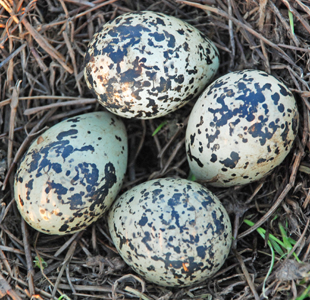
Breeding and nesting can occur as early as July in the northern part of the country and can continue into summer. Nests are usually built on the edge of wetlands/lagoons or above the high-tide mark on sandy beaches and riverbeds. The stilts are very vocal at this time of year and if an intruder ventures too close to their nest or young they make sharp yapping calls and  often feign a broken wing in order to draw attention away from their exposed nest or young. The female usually lays four eggs which are incubated by both parents. Incubation usually lasts for 25 days. The chicks usually leave the nest the same day after hatching and are covered with a soft down with speckled yellow-brown upper-parts and white under-parts. When danger threatens they drop straight to the the ground and remain motionless becoming extremely difficult to detect. 


Above: A young stilt finds its legs on the estuary mud
Right: A pied stilt incubates it's eggs in waterlogged pasture.


Left: A newly hatched chick sits on its nest, stilt chicks usually leave the nest the same day. 

Below: A newly hatched chick soaks up some rays, a relief after being cramped in the egg for 25 days :)

Friday, October 8, 2010

Local wanderings

I'm working on a few photographic projects at the moment and I've been able to spend a fair bit of time down at my local estuary (Avon/Heathcote) here in Christchurch. While some projects are in the making I thought I'd add a few shots that I've taken this week in between photographic ventures. I really enjoy getting to know the ins-and-outs of the estuary and I find that the more time I spend down there the more I learn about the habits and behaviours of my feathered friends :)

Photos from top to bottom. Backlit white-fronted tern. Mallard duckling. NZ kingfisher and crab. Shag Rock a prominent feature of the Avon/Heathcote Estuary (an older photo). 


Friday, October 1, 2010

LOVE IS IN THE AIR

'LOVE IS IN THE AIR' 

The white-fronted terns' noisy chattering is a sure sign that spring is underway! From now (October) to January these birds will breed on sand dunes, rocky islets and shingle banks around the country. Males court females by delivering fish held crosswise in their bill. I can't help feeling a little sorry for these small fish which are often still alive and kicking as they are held in the male's beak for a few minutes and then offered as a gift... I wonder what the fish is thinking? 

White-fronted Terns (Sterna striata) are the most common tern in New Zealand. Unfortunately recent counts have shown that their numbers are declining quite rapidly!

The reasons for this are not fully known, although it is thought that disturbances to their breeding habitats such as 4WD vehicles and predation from rats, stoats, hedgehogs, black-backed gulls etc. have all contributed to this decline.

White-fronted terns are also known as 'kahawai birds' as they are often seen feeding with schools of kahawai (Australian Salmon) that push krill and small fish like smelt and pilchards to the surface making it easier for the terns to feed. It is therefore also quite likely that the over-fishing of kahawai may also be contributing to their decline.